














|


Guests of Phantasm
Susanna Pell, tenor viol, was born in Leicester and is a member of the viol
consort Fretwork and medieval ensemble, The Dufay Collective. With both groups
she has toured throughout the world and made many recordings for TV, radio, disc
and film. She is also a member of Virelai, an ensemble specialising in music of
the late medieval and early renaissance period. Susanna teaches consort playing
at King's College London and is currently training to be a teacher of the
Alexander Technique.
Asako Morikawa, born in Takamatsu, Japan, started playing viola da gamba when
she was 13 years old, but initially studied violin in the Toho Gakuen Music High
School in Tokyo, before continuing her studies in viola da gamba at the
Conservatorium with Tetsuya Nakano. In 1988 she moved to Holland to further her
studies with Wieland Kuijken at the Royal Conservatorium in The Hague, where she
received her Soloist's Diploma in 1993. Since 1997 she has made her home in
London and has appeared internationally with groups such as Charivari Agreable,
The English Concert, The King's Consort, and Fretwork.
About this recording:
Viol players, it would seem, have little in common with the pianist Glenn Gould
(1932-1982), until when one learns that the Canadian counted - not JS Bach but -
Orlando Gibbons (1583-1625) as his 'favourite composer'. 'Ever since my teen-age
years his music has moved me more deeply than any other sound experience I can
think of', he writes. Above all, Gould loved the choral anthems - he admits to
wearing out three copies of an Archiv recording (ARC 3053) by the Deller Consort -
but he also recorded some of Gibbons's keyboard works (including the 'Salisbury'
Pavan on our disc), praising their 'imperishable, distinctly English brand of
conservatism'. Gould even mentions Gibbons in the same breath as Wagner: 'Given
a hard day, a late night, and a sequence or two from the Liebestod, the spine
tingles and the throat is seized by a catch that no other music, this side of
Orlando Gibbons's anthems, can elicit with equivalent intensity and
predictability'.
Sadly, Gould didn't know Gibbons's consort music - little was in print at the
time - but perhaps he'd have transcribed some for piano, that is, if the
persistent cross-rhythms and dense part-writing didn't foil him. For while Gould
didn't shirk from 'helping out' Wagner by adding some extra voices in his
transcription of Die Meistersinger, he stopped short of tackling Richard Strauss's
late Metamorphosen for twenty-three strings with the excuse, 'I haven't got that
many fingers'.
Writing for no more than six viols, Gibbons pulls off not a few polyphonic
stunts of his own. To begin with, there are the six-part fantasies, gems like no
others, composed with a fluency of idiom and with such a concentration of ideas
that they're best heard as a group. Listening to them is like peering into a
kaleidoscope: one can decide to follow the fortunes of one pattern over that of
another, thereby gaining new insights each time into the coherence of the whole.
Not that one knows exactly where to fix one's attention, even when the patterns
appear exceedingly simple. Just try counting along with the opening of Fantasia
V (Track 1) to find the pulse, and you'll see what I mean: the Elysian fields of
consort playing are littered with those who, even after several tries, still
failed to enter on the right beat. And no wonder. Should one count the piece in
two? In three? Correct answer: both and neither, which is why it's so engrossing
to play this music as it was intended, without bar lines. And yet, for all the
metrical conflicts, Gibbons manages to produce the most glorious euphony -
nothing short of miraculous, really. For the most extreme frolics of metrical
confusion and energetic counterpoint, one can attempt to keep track of the cross-accents
in the last minute of Fantasia IV (Track 6). The term 'syncopation' simply doesn't
cover it.
The brevity of some imitative points, such as in the middle of Fantasia IV, (Track
6), creates a dazzling array of lightening flashes, with each strike visible if
never predictable in its location. Then there are those wonderful moments of
Mendelssohnian lightness in every piece, capturing what Baudelaire later rightly
called 'the extraordinary sensuality which stirs in high places' (l'extraordinaire
volupte qui circule dans les lieux hauts). Then there is the undeniable
sincerity of Gibbons's pathos. Good examples are the openings of Fantasias VI
and III (Tracks 2 and 3), which weave their tale of woe with a lyrical
melancholy quite unlike Byrd's more awestruck ruminations. (Might this be where
Gibbons, a man of the established church, parts company with Byrd the anxious
Catholic?) Yet Gibbons has an obsessive side to his character, seen in his
refusal to relinquish his control of a motive, a passion that gives his
polyphony a staying power which few contemporaries can match.
This tenacity can assume the form of mock-heroism, as in the opening of Fantasia
I, or of full-blooded Elizabethan muscularity at its end (Track 4). In Gibbons's
hands, in fact, the consort fantasia develops into a confessional genre, whose
rhetoric lies in the revelation of contrasting but related states of mind. Byrd's
great viol fantasies are no less deeply felt, but there is a more pronounced
element of public display found in them, especially in the five- and six-part
works, with their motet-like openings, and calculated moves into popular tunes
or dances. There is good reason why William Lawes pilfers some of Gibbons's most
original ideas, like the falling thirds just after the opening of Fantasia II (Track
5), which conclude Lawes's first Fantasy in F major a6 but which (turned upside
down) provide the germ for the entire piece.
The Pavan and Galliard pair a6 (Tracks 19 and 20) inhabit a different world
altogether, and indulge merrily in courtly pleasures and raucous high-jinks.
These are pieces which invite a sympathetic stomping of the feet, even if
Gibbons's examples of the dance genres are highly unorthodox. And nothing
conveys better the joyful vagaries of Gibbons's invention than 'Go from my
window' (Track 21) with its riot of divisions for the two bass viols erupting
just before the conclusion.
Finally a word about the 'borrowed' pieces on this recording, which explore the
intimate links between Gibbons's consorts and their neighbouring genres. No
excuses are offered for the inclusion of the familiar 'Silver Swan' (Track 12):
Gibbons himself advertised his collection of madrigals (1612) as 'apt for voices
or viols'. Perhaps the instrumental rendition of sacred anthems (Tracks 17 and
18) can likewise be licensed in the way it exposes the affecting musical
substance, even with the words absent. 'O Lord, in thy wrath' (Track 17), as it
happens, begins with the same counterpoint as the opening of Fantasia V (Track 1),
though to wildly contrasting effect. In the case of the keyboard pieces (Tracks
9 to 11), our production schedule was too advanced to heed the strongly worded
advice of - not one but - two eminent Fellows of the British Academy, who warned
against releasing such versions in the public domain. Stick to your own
repertoire, I was told, rather than muck about in someone else's. Perhaps they
were right, although the temptation to unravel the filigree strands of Gibbons's
exacting part-writing proved, in the end, irresistible. Portrayed by four viols,
the 'excruciatingly expressive' dissonances in the 'Salisbury' Pavan so beloved
of Glenn Gould convey a special poignancy, whilst the sparks that fly around 'Peascod
Time' (variations based on that tune as well as on the ground bass 'The Hunt's
Up') are similar enough to those given off in 'Go from my window' to make one
dream of an entire corpus of English consort divisions crafted by the
incomparable Orlando.
- Laurence Dreyfus
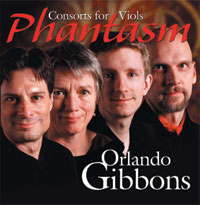
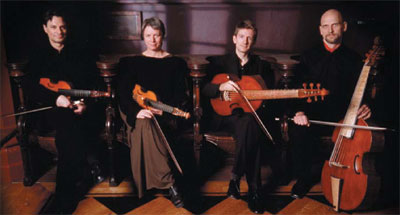
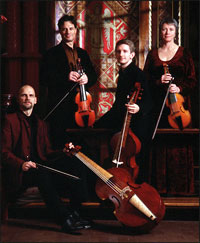 Phantasm, an award-winning quartet of viols, was founded in 1994 by Laurence
Dreyfus. Inspired by the great twentieth-century string quartets, Phantasm
enjoys taking risks in its search for renditions that renew the expressive
traditions of early music. The quartet's international membership (from Britain,
Finland and the US) were all trained on modern instruments, but each was drawn
to consort playing because of the poignant sound of the viols and the special
intimacy this music cultivates. Based in London, Phantasm has toured extensively
throughout Europe, North America, and East Asia. They have appeared in festivals
in London, York, Berlin, Utrecht, Stavanger, as well as in Iceland, Estonia,
Poland and Finland and on concert series in Tokyo, Seoul, New York and
Washington.
Phantasm, an award-winning quartet of viols, was founded in 1994 by Laurence
Dreyfus. Inspired by the great twentieth-century string quartets, Phantasm
enjoys taking risks in its search for renditions that renew the expressive
traditions of early music. The quartet's international membership (from Britain,
Finland and the US) were all trained on modern instruments, but each was drawn
to consort playing because of the poignant sound of the viols and the special
intimacy this music cultivates. Based in London, Phantasm has toured extensively
throughout Europe, North America, and East Asia. They have appeared in festivals
in London, York, Berlin, Utrecht, Stavanger, as well as in Iceland, Estonia,
Poland and Finland and on concert series in Tokyo, Seoul, New York and
Washington.
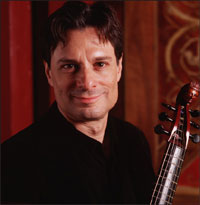 Laurence Dreyfus, treble viol and director, was born in Boston, Mass. After
learning the cello with Leonard Rose at Juilliard, he studied the viol with
Wieland Kuijken at the Royal Conservatoire at Brussels, which awarded him its
Diplome sup?eur. As a bass viol player, he has recorded CDs of Bach's viola da
gamba sonatas, Marais's Pieces de violes and Rameau's Pieces de clavecin en
concert (all on Simax), and collaborated with Silvia McNair in a Grammy-winning
album of Purcell songs (on Philips). As a musicologist, Laurence has published
Bach's Continuo Group and Bach and the Patterns of Invention (Harvard, 1987 and
1996); the latter won the Kinkeldey Award from the American Musicological
Society for the best book of the year. Dreyfus taught at Yale, the University of
Chicago, Stanford, and the Royal Academy of Music before becoming Thurston Dart
Professor in 1995 at King's College London, where he teaches music history and
performance. In 2002 he took British citizenship and was elected a Fellow of the
British Academy.
Laurence Dreyfus, treble viol and director, was born in Boston, Mass. After
learning the cello with Leonard Rose at Juilliard, he studied the viol with
Wieland Kuijken at the Royal Conservatoire at Brussels, which awarded him its
Diplome sup?eur. As a bass viol player, he has recorded CDs of Bach's viola da
gamba sonatas, Marais's Pieces de violes and Rameau's Pieces de clavecin en
concert (all on Simax), and collaborated with Silvia McNair in a Grammy-winning
album of Purcell songs (on Philips). As a musicologist, Laurence has published
Bach's Continuo Group and Bach and the Patterns of Invention (Harvard, 1987 and
1996); the latter won the Kinkeldey Award from the American Musicological
Society for the best book of the year. Dreyfus taught at Yale, the University of
Chicago, Stanford, and the Royal Academy of Music before becoming Thurston Dart
Professor in 1995 at King's College London, where he teaches music history and
performance. In 2002 he took British citizenship and was elected a Fellow of the
British Academy.
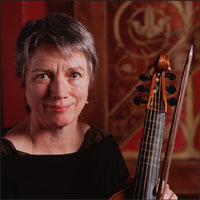 Wendy Gillespie, treble viol, was born in New York and, after attending
Wellesley College and the Amsterdam Conservatoire, began her performing career
with the New York Pro Musica Antiqua. Since then she has played all over the
world with leading ensembles including Les Filles de Sainte-Colombe, Ensemble
for Early Music, Ensemble Sequentia, the Waverly Consort and the English Concert.
She has participated in over 60 recordings for Virgin Classics, Decca, Nonesuch,
Harmonia Mundi, among others. Whilst her speciality lies in consort music, Wendy
has participated in many performances of both medieval and contemporary music.
Wendy is a founding member of the viol consort Fretwork, who appear worldwide
and have won a Grand Prix du Disque. Wendy makes her home in Bloomington, where
she is Associate Professor at Indiana University and Acting Director of the
Early Music Institute.
Wendy Gillespie, treble viol, was born in New York and, after attending
Wellesley College and the Amsterdam Conservatoire, began her performing career
with the New York Pro Musica Antiqua. Since then she has played all over the
world with leading ensembles including Les Filles de Sainte-Colombe, Ensemble
for Early Music, Ensemble Sequentia, the Waverly Consort and the English Concert.
She has participated in over 60 recordings for Virgin Classics, Decca, Nonesuch,
Harmonia Mundi, among others. Whilst her speciality lies in consort music, Wendy
has participated in many performances of both medieval and contemporary music.
Wendy is a founding member of the viol consort Fretwork, who appear worldwide
and have won a Grand Prix du Disque. Wendy makes her home in Bloomington, where
she is Associate Professor at Indiana University and Acting Director of the
Early Music Institute.
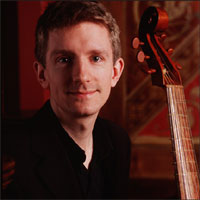 Jonathan Manson, tenor viol, was born in Edinburgh and received his formative
training at the International Cello Centre in Scotland under the direction of
Jane Cowan, later going on to study with Steven Doane at the Eastman School of
Music in New York. While in America, he became involved with the performance of
early music, and from there went to The Hague to study viola da gamba with
Wieland Kuijken. On both cello and viola da gamba, Jonathan plays and records
regularly with many leading early music ensembles. Recent chamber music
recordings include a disk of Rameau's Pieces de clavecin en concert with Rachel
Podger and Trevor Pinnock. In 1999, he became principal cellist of the
Amsterdam Baroque Orchestra, which in addition to a busy touring schedule has
just finished recording the complete cantatas of JS Bach. Jonathan makes his
home outside of London, where he has been appointed a professor at the Royal
Academy of Music in London.
Jonathan Manson, tenor viol, was born in Edinburgh and received his formative
training at the International Cello Centre in Scotland under the direction of
Jane Cowan, later going on to study with Steven Doane at the Eastman School of
Music in New York. While in America, he became involved with the performance of
early music, and from there went to The Hague to study viola da gamba with
Wieland Kuijken. On both cello and viola da gamba, Jonathan plays and records
regularly with many leading early music ensembles. Recent chamber music
recordings include a disk of Rameau's Pieces de clavecin en concert with Rachel
Podger and Trevor Pinnock. In 1999, he became principal cellist of the
Amsterdam Baroque Orchestra, which in addition to a busy touring schedule has
just finished recording the complete cantatas of JS Bach. Jonathan makes his
home outside of London, where he has been appointed a professor at the Royal
Academy of Music in London.
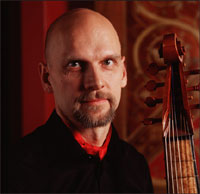 Markku Luolajan-Mikkola, bass viol, studied cello with Arto Noras at the
Sibelius Academy in Helsinki, which awarded him its diploma in 1983. An interest
in baroque music led him to a summer course in Norway with Laurence Dreyfus and
later to Holland where he studied with Wieland Kuijken at the Royal Conservatory
of The Hague and received postgraduate diplomas in viola da gamba and baroque
cello. Markku teaches at the Sibelius Academy. He is active as a chamber
musician and has given many solo recitals throughout Scandinavia as well as in
the Netherlands, Italy, Russia, Estonia, and Poland. His recording of Marais'
Suite d'un gout Etranger on ALBA records won a national award for excellence in
his native Finland, and other solo CDs have likewise garnered critical acclaim,
including discs of virtuoso viol music by Forqueray, Marais, and JS Bach's gamba
sonatas, the latter two issued by BIS. A special interest of Luolajan-Mikkola's
is contemporary music commissioned for the bass viol.
Markku Luolajan-Mikkola, bass viol, studied cello with Arto Noras at the
Sibelius Academy in Helsinki, which awarded him its diploma in 1983. An interest
in baroque music led him to a summer course in Norway with Laurence Dreyfus and
later to Holland where he studied with Wieland Kuijken at the Royal Conservatory
of The Hague and received postgraduate diplomas in viola da gamba and baroque
cello. Markku teaches at the Sibelius Academy. He is active as a chamber
musician and has given many solo recitals throughout Scandinavia as well as in
the Netherlands, Italy, Russia, Estonia, and Poland. His recording of Marais'
Suite d'un gout Etranger on ALBA records won a national award for excellence in
his native Finland, and other solo CDs have likewise garnered critical acclaim,
including discs of virtuoso viol music by Forqueray, Marais, and JS Bach's gamba
sonatas, the latter two issued by BIS. A special interest of Luolajan-Mikkola's
is contemporary music commissioned for the bass viol.
 Strong stuff, I know, and some people might chalk it all up to the eccentricity
of a genial but perverse pundit who left the real world of 'staged' performance
so as to bang on endlessly about the joys of counterpoint, of the recording
studio, and of the 'North'. To lovers of consort music, however, one can't
praise Gibbons highly enough, and Gould must be forgiven for his Schwarmerei,
that untranslatable German term for a gushing idol-worship which summons forth
images of swarms of likeminded enthusiasts unable to contain their fervour.
Strong stuff, I know, and some people might chalk it all up to the eccentricity
of a genial but perverse pundit who left the real world of 'staged' performance
so as to bang on endlessly about the joys of counterpoint, of the recording
studio, and of the 'North'. To lovers of consort music, however, one can't
praise Gibbons highly enough, and Gould must be forgiven for his Schwarmerei,
that untranslatable German term for a gushing idol-worship which summons forth
images of swarms of likeminded enthusiasts unable to contain their fervour.
 The greater austerity of Gibbons's In Nomines a5 (based on the venerable cantus
firmus) shows him to no less splendid advantage. In the first In Nomine,
respectful references to Taverner and Byrd give way to the treatment of a pavan-like
figure, which mischievously injects a sweetness alien to the genre. The second,
on the other hand, one of Gibbons's most ambitious pieces, is saturated with an
ecstatic mysticism. The enigmatic opening unleashes chains of falling
tetrachords, all syncopated, as if one were dragging a heavy burden across the
tonal expanse. The lamenting descent meets its inverted alter ego, and from then
on, rising dactyls soar upwards, creating an illusion of continuously ascending
spirals which exhaust themselves only at the rapturous final cadence.
The greater austerity of Gibbons's In Nomines a5 (based on the venerable cantus
firmus) shows him to no less splendid advantage. In the first In Nomine,
respectful references to Taverner and Byrd give way to the treatment of a pavan-like
figure, which mischievously injects a sweetness alien to the genre. The second,
on the other hand, one of Gibbons's most ambitious pieces, is saturated with an
ecstatic mysticism. The enigmatic opening unleashes chains of falling
tetrachords, all syncopated, as if one were dragging a heavy burden across the
tonal expanse. The lamenting descent meets its inverted alter ego, and from then
on, rising dactyls soar upwards, creating an illusion of continuously ascending
spirals which exhaust themselves only at the rapturous final cadence.

